
- News
- Horse Racing
- Racing Preview
- AQHA Racing Challenge
- Breeding
- Sales
- Quick Stakes Results
- Detail Race Results
- Qualifiers
- Leader Board
- Leading Sires
- Videos
- Auction Leaders
- Q-Racing
Streaming Video
News

By Leann Noguera, StallioneSearch
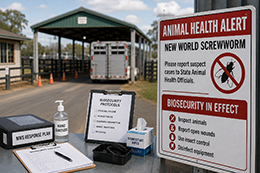
AMARILLO, TX–JUNE 18, 2026–The American Quarter Horse Association has distributed guidance documents outlining current protocols and biosecurity recommendations related to the ongoing response to New World Screwworm (NWS), as horse industry organizations and regulatory agencies continue preparations following the parasite's recent detection in Texas.
While the AQHA materials are primarily directed toward horse shows and equine events, the information provides horse owners, trainers, breeders, and racing participants with important resources as state agencies develop response plans tailored to their jurisdictions.
TEXAS RACING INDUSTRY PREPARES FOR NWS RESPONSE
In Texas, discussions regarding New World Screwworm preparedness are already underway ahead of the upcoming racing season and TQHA Yearling Sale.
According to Texas Quarter Horse Association Executive Director and Director of Racing Scott Sherwood, Retama Park will host a Welcome Back Horsemen Luncheon on Thursday, June 25, beginning at 11:30 a.m. in the racetrack's Racing Office area.
During the luncheon, representatives from the Texas Racing Commission will discuss a potential phased operations plan designed to prepare for upcoming race meets and establish effective response measures related to New World Screwworm.
The Texas Quarter Horse Association is encouraging anyone transporting horses into or out of Texas racetracks to attend the discussion.
TQHA also recommends that racehorse owners notify their trainers so they can make arrangements to participate. Handouts detailing proposed procedures are expected to be distributed during the meeting and will be available in both English and Spanish.
FEDERAL RESTRICTIONS IMPACT INTERNATIONAL HORSE MOVEMENT
The heightened attention follows recent federal actions affecting livestock movement and international trade.
Mexico's National Service for Agri-Food Health, Safety and Quality (SENASICA), through its General Directorate of Animal Health, issued a June 8 directive temporarily suspending the importation of horses from the United States to Mexico. The action applies to horses imported for breeding, work, sport, exhibition, and slaughter and will remain in effect while Mexican animal health officials evaluate additional biosecurity measures and entry requirements.
The directive took effect immediately and will remain in place pending further guidance from Mexican authorities. In addition to horses, the restrictions apply to cattle, wild ruminants, sheep, goats, swine, ferrets, birds, and pet dogs.
ABOUT NEW WORLD SCREWWORM
New World Screwworm re-emerged as a significant animal health concern after the USDA confirmed a case in Texas on June 3, 2026. The parasite is the larval stage of the New World screwworm fly and differs from most fly larvae because it feeds on living tissue rather than dead or decaying flesh.
Female flies deposit eggs in open wounds or vulnerable areas of warm-blooded animals. Once the eggs hatch, typically within 24 hours, the larvae begin feeding aggressively on living tissue for approximately one week before dropping to the ground to pupate and develop into adult flies.
Horses, cattle, livestock, wildlife, pets, and humans can all become hosts. If left untreated, infestations can cause severe tissue damage and may become life-threatening.
Federal and state animal health officials have responded by establishing infested zones around confirmed cases and implementing movement restrictions in affected areas. A primary component of the eradication strategy involves the release of sterile male screwworm flies, which mate with wild females and produce infertile eggs. The technique was instrumental in eliminating screwworm from the United States decades ago and remains a cornerstone of current control efforts.
Veterinarians and horse owners are being urged to closely monitor animals for wounds, irritation, foul odors, discharge, or visible larvae. Officials recommend paying particular attention to healing surgical sites, umbilical areas, lips, nostrils, eyes, and genital regions where flies are known to deposit eggs.
Prompt wound care, aggressive fly control programs, manure management, and regular inspections are considered critical preventive measures as officials work to contain the parasite and prevent further spread.
AQHA's distributed materials include additional guidance and resources intended to help horse owners and event organizers understand current recommendations and reporting procedures as the industry responds to the developing situation. CLICK HERE for more information.
* * * * * * * * * * * * * * *
Would you like more industry news delivered directly to your inbox? Click here to sign up.
|
||
 Newsletters
 Facebook
Copyright © 2026 StallioneSearch, LLC, All rights reserved internationally.